Emotional intelligence and feedback: how to give feedback that gets heard
Next week Cohort 27 of LEAD™ take part in their Introduction to Shadowing. Each delegate spends time inside another delegate's business, watching how the organisation runs and how their partner leads, then sits down with that person and gives them feedback on both.
That conversation is harder than it sounds. You have no authority over the person you are giving feedback to, you're working from a single visit rather than months of observation, they've just trusted you with their business, and you will be sitting in a room with them at every module for the rest of the programme.
Most feedback conversations in an SMB share at least some of those conditions. You are close to the person, you rarely have the full picture and you have to carry on working alongside them afterwards. Whether your message is heard or defended against usually comes down to emotional intelligence.
What is emotional intelligence?
Emotional intelligence, often shortened to EI, is the ability to understand and manage your own emotions, recognise what other people are feeling and use that information to guide how you think and behave.
Daniel Goleman popularised the term and called it the "sine qua non of leadership". His argument was that training, analytical ability and a supply of good ideas will only take a leader so far without it.
Goleman set out four aspects of emotional intelligence:
- Self-awareness
- Self-management, including emotional self-control and motivation
- Social awareness, including empathy
- Relationship management
Why does emotional intelligence matter when you give feedback?
Performance feedback is one of the most effective ways to help people learn and develop, and regular feedback contributes to motivation, commitment and engagement at work. Both people have to manage the emotion in the room before any of that content gets through.
Each of Goleman's four aspects changes how well you give feedback and how well you receive it.
1. Self-awareness: how do you know how you come across?
Self-awareness in feedback means understanding the gap between what you intend and what other people experience. You see the reasoning behind your behaviour while everyone else sees its effect, so asking for feedback is the most reliable way to find out how wide that gap has become.
When feedback comes your way, treat it as information rather than a verdict:
- Listen to the whole point before you respond. Explaining and justifying yourself tends to close the conversation down early.
- Ask for examples. "When did you notice that?" gives you something specific to work with.
- Thank the person even where you disagree with them. People stop offering feedback to leaders who argue with it.
- Take time to reflect before you decide what action you want to take.
- Go back and tell them what you have decided. Closing the loop is what turns feedback into a change other people can see.
On shadowing day this works in both directions. You are giving your partner a view of their business that they cannot get from inside it, and within the same session you will be asked to sit still and hear the same about yours.
2. Self-management: how do you stay calm in a difficult conversation?
Our own feelings are often the barrier. We do not want to upset someone, we want to be liked by our team, or we would rather not deal with the reaction we expect. The conversation gets postponed, poor performance goes unaddressed and a small issue turns into a formal one.
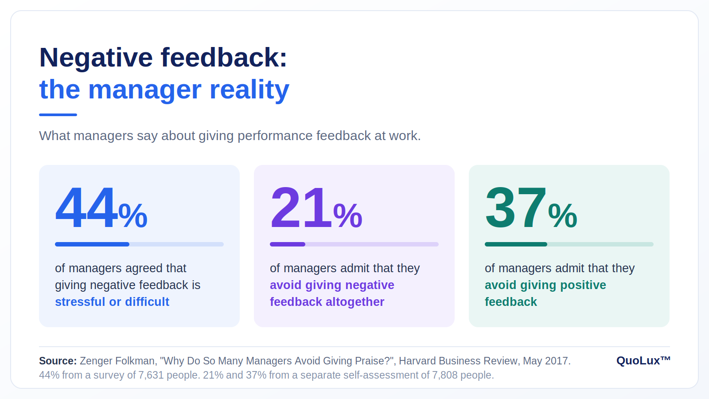
Jack Zenger and Joseph Folkman put numbers to this in Harvard Business Review. In a survey of 7,631 people, 44% agreed that giving negative feedback was stressful or difficult. A separate self-assessment of 7,808 people found that 21% admitted to avoiding it altogether. More surprisingly, 37% avoided giving positive feedback.
Receiving critical feedback creates its own difficulty. The brain reads it as a threat and engages our defensive mechanisms, and the resulting fight or flight response makes clear thinking hard. That is why people often remember how a piece of feedback felt long after they have forgotten what it was about.
Emotional self-control lets you raise a difficult subject while staying calm and keeping the conversation on track. It also lets you recognise the moment your own emotions have taken over so that you can regain your composure. Four habits help:
- Notice what you are feeling before the meeting starts, particularly if you are irritated. Feedback delivered in frustration rarely has the effect you intended.
- Plan your opening sentence. The first few seconds set the tone for everything that follows.
- Leave silences rather than filling them. Giving the other person room to think is more useful than adding another example.
- Say so if you feel yourself reacting, and ask for a short break or a second conversation.
3. Social awareness: how do you make feedback feel supportive?
Studies consistently show that people who receive constructive feedback from a leader who expresses empathy are more likely to respond positively. Empathy is the ability to listen, understand how someone else feels and see the situation from their side.
In practice it means asking questions before you offer your view:
- What is getting in the way?
- What support or resource is missing?
- Is the difficulty capability, capacity, clarity or something happening outside work?
- What would need to change to make this easier next time?
Taking that time shows the person that you are giving feedback to help them perform better rather than to criticise them, and they will accept it far more readily on that basis.
Empathy does not mean lowering the standard. You can be clear about what needs to change and still be interested in why it has not changed yet.
A shadowing visit makes the point sharply. You are seeing a business on one day, without the history, the constraints or the reasons behind decisions that were taken long before you arrived. Asking before concluding turns an unwelcome opinion into a useful observation.
4. Relationship management: how do you turn feedback into change?
Goleman described relationship management as the point where self-awareness, self-management and empathy come together, and summed it up as "handling other people's emotions".
Influence, communication, developing others and conflict management all belong here, and all of them shape how effective your feedback is. Specific, timely and useful feedback influences people to act, while vague or delayed feedback tends to be absorbed and forgotten.
Leaders with strong conflict management skills deal with the awkward conversation early and constructively rather than avoiding it. Preparing properly and structuring the conversation keeps it focused on facts, behaviour and the performance outcome you want, rather than on personality. Two habits make the biggest difference:
- Agree the actions out loud at the end and put a date in the diary to review them, so the conversation produces something you can both point to later.
- Give the feedback close to the event. Saved for an appraisal six months later, the detail has gone and the behaviour has been repeated many times over.
Five questions to ask before a feedback conversation
1. What did I actually observe and what effect did it have? Describe behaviour rather than applying a label.
2. What do I want to be different afterwards?
3. What might they say and how will I respond without becoming defensive?
4. Is this the right time and place, and is it private?
5. How and when will we review it?
Download your 10-step guide to giving constructive feedback here
Frequently asked questions
What is emotional intelligence in leadership? Emotional intelligence in leadership is the ability to understand and manage your own emotions, read the emotions of your team and use that understanding to guide your decisions and behaviour. Daniel Goleman identified four aspects: self-awareness, self-management, social awareness and relationship management.
How does emotional intelligence improve feedback? Emotional intelligence helps the person giving feedback stay calm, choose the right moment and understand the pressures the other person is under. It helps the person receiving it recognise their own defensive reaction and listen to the content rather than the tone.
Why do people become defensive when receiving feedback? The brain interprets criticism as a threat and triggers a fight or flight response, which makes clear thinking difficult. Recognising that reaction in yourself is a self-management skill, and reducing the likelihood of it in others is a matter of empathy, timing and describing behaviour rather than character.
How do you give feedback to a peer rather than a direct report? Without positional authority you rely entirely on the relationship. Ask questions before drawing conclusions, describe what you saw rather than what you assumed, be specific about the effect it had, and agree together what happens next. Shadowing on LEAD™ is built around exactly this kind of conversation.
Where this leaves you as a leader
A leader's emotional intelligence plays a decisive role in their ability to give effective feedback and to receive it, and both sides of that can be developed with practice. Delegates on LEAD™ get to test it in a live business rather than just read about it, which is why shadowing tends to be one of the elements delegates talk about long after the programme finishes.
If you would like to work on this alongside other senior leaders, our next LEAD™ programme starts on 5th and 6th November. Please contact us here for more information.
Keep up-to-date on the latest leadership and management tips by signing up to our weekly blog here