How to Draw up a Business Plan for Good Growth - In a Weekend
Two-thirds of UK firms don’t have a business plan, which might lead many to think if they’re doing fine, why bother? Imagine how much better they could do if they knew where they’re going and why.
This article first appeared on 2nd June in The Raikes Journal after leading county journalist Andrew Merrell joined QuoLux™ at our Realising Good Growth book launch at the University of Gloucestershire last month:
Even events led by best-selling authors of business-focused books don’t tend to have the same draw as their peers in fiction, but try telling that to those who almost filled a lecture theatre at the University of Gloucestershire recently.
Almost fifty businesspeople took the limited tickets available to hear Dr Stewart Barnes and Professor Steve Kempster interviewed by Jo Draper of leadership development specialist QuoLux™ about their book, Realising Good Growth: A Practical Guide for Business Leaders.
Why so much interest?
Generally, growth has become such a challenge for UK plc that the Prime Minister and Chancellor are obsessed with it. In 2025 GDP was 1.4 per cent and in the first quarter of 2026 0.6 per cent. Perhaps they should have hightailed it down to Oxstalls to listen to the debate...
More specifically, most attended because they know that the organisation which has been road-testing the ideas in the book, which Barnes also co-founded, is onto something.
Gloucester-based QuoLux™ delivers leadership development and growth for businesses and organisations across the UK and beyond.
Its cohort now numbers more than 1,000, and businesses and organisations it’s worked with have, on average, enjoyed increases in sales (up 42 per cent), productivity (up 47 per cent), employee growth (up 19 per cent) and profitability (up 197 per cent).
What makes it doubly appealing is this is not just about leadership and growth with a focus on profit only.
In a world where we now understand growth comes with costs for us and our planet – what Kempster calls one of the ‘moral challenges’ of out time – their book describes ‘good growth’, growth that results from a business that has become a force for good.
But to achieve that, said Barnes, you first need to have a good understanding of your business - and a plan.
Realising Good Growth book event photo reel May 2026
“Two thirds of businesses don’t have a plan. You can take this book, work through it, and produce a business plan in the space of a week,” he said.
Build the right plan, the pair argue, and you really can achieve that positive impact.
If you’ve heard of B Corp, the book explores similar ideas: that by focusing on key areas, including people and planet, a business can achieve what Kempster has coined Good Dividends.
The thinking is that a purpose-led business that is conscious of its impact on people, planet and community – that works to achieve social value with every step – will be more driven, more focused, more engaged, more impactful and more profitable.
It will deliver what Kempster calls a virtuous circle of good dividends, where relationships sustain and grow because people buy into what the business is and what it does, staff are engaged and productivity is up.
Their text takes and beautifully distils these ideas into a handbook for action, a Haynes manual for your business; simple to follow, bite-sized chunks with inspirational quotes and QR codes pointing you to digital tools to help build that business plan.
It maps a process that will help business leaders better understand what their company stands for, what benefits it delivers, what it is doing that is positive and to help them bring those key messages to the fore to create that purpose-led ethos.
“You can do this on your own or with your senior management team, over a number of sessions or in a couple of days. You should be able to easily achieve a concise, single-page business plan,” said Barnes.
“Some of the businesses that have done this already have these plans hanging on walls around their business for everyone to see, to remind them of what they stand for.”
Cathia Jenainati, professor of gender and leadership and head of the School of Business, Computing and Social Sciences at the University of Gloucestershire, asked Barnes and Kempster whether there was evidence their methods could benefit every member of society equally.
And Abby Guilding, director of fundraising for the charity Well Child, said: “From a charity’s perspective, we need to find partners to support us. It is incredibly challenging out there in this respect. Can we use the techniques you talk about to show companies what they can get from partnering with us, to help them better understand how the relationship will generate value?”
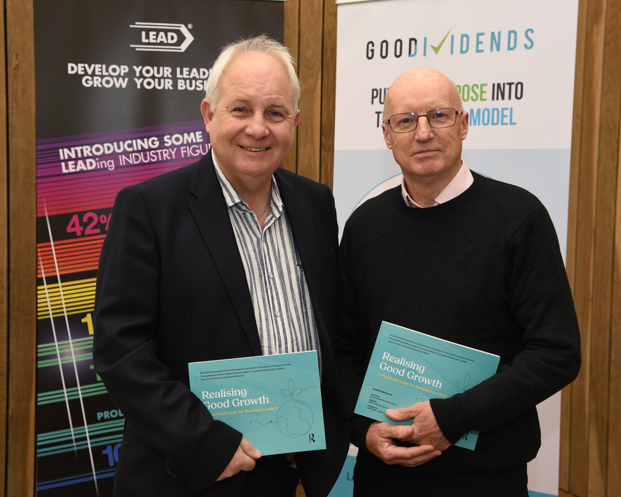 Stewart Barnes and Steve Kempster, authors of Realising Good Growth, holding their book at the book launch at the University of Gloucestershire in May 2026
Eighteen powerful, real case studies in the book include the story of Cotteswold Dairy’s radical solution to its employment churn – taking on and training inmates from a nearby prison, employing the best of them when they have served their sentences.
Rather than put its existing 450 staff on the defensive, the counterintuitive thinking engaged staff at all levels, created a new-found sense of what sort of business Cotteswold Dairy stands for and wants to be, it empowered staff to shape that reality which further motivated and enthused, and in providing meaningful work for former inmates it helped solve the issue of staff turnover.
“It also added a quarter of a million pounds saving to the bottom line,” said Kempster, underlining his earlier point - that energy spent creating purpose also drives profit.
Barnes also pointed both of them to the case study of The Nelson Trust and what QuoLux™ calls its SGD Configurator, a digital tool found via a QR code in the book.
It allows firms to quickly map what they do across the 17 Sustainable Development Goals and the 169 targets of the United Nations, criteria widely used by major firms to help make procurement decisions.
These SDGs include ensuring an organisation’s actions deliver no poverty, zero hunger, quality education, gender equality, reduced inequalities, affordable clean energy, decent work and economic growth, industry, innovation and infrastructure, reduced inequalities, sustainable cities and communities.
The Gloucestershire-headquartered Trust is a charity that supports people dealing with substance addictions. Up against a major competitor in a bidding process, it needed to communicate the impact it had.
It used the SGD configurator to help it demonstrate its impact, and credits it as key to a dramatic win that led to a near doubling of its ‘turnover’ overnight. It makes for powerful reading.
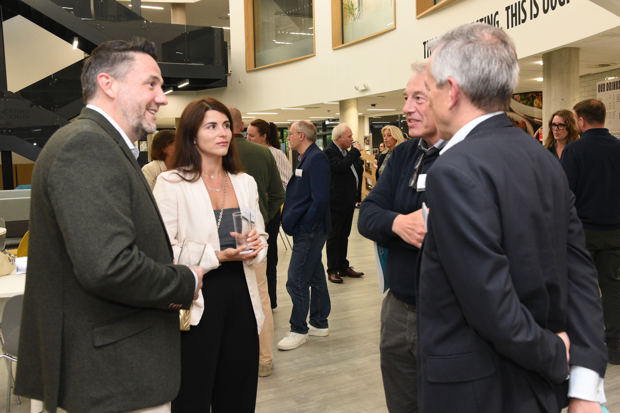
Guests at the QuoLux™ Realising Good Growth book launch at the University of Gloucestershire in May 2026
“In these cases, fully engaged people led to great business wins. Business flourishes, communities flourish, the whole planet flourishes,” said Barnes.
“This is exactly what the book is meant to help address. It is about having purpose-led conversations about how we can create these benefits for others outside the business.
“The challenge is that often no one has any experience of having such conversations. It’s about little steps, about learning.
“Seven out of 10 businesses in the UK don’t have any training to help them do that.
“Most of them went into business with purpose, but they forget along the way as the business takes over.
“Reminding themselves, re-evaluating, identifying what it is they do and why they do it will help them focus on where they want to go and what impact they want to make. It can be transformational.”
The preface to the book says: “We can change the nature of growth, reframe the purpose of business and galvanise leadership. Too often we think it is all down to governments to address these issues.
“For sure, they establish incentives and punishments to guide our behaviours, but they are not the engine room for change – and certainly not with regard to growth.
“That lies with business and the leaders of these businesses. If we say countries and companies are both ‘entities’, then 150 of the top 200 largest entities in the world, defined by size, are companies.
“But these are just the largest businesses … picture the 150 as the tip of a huge pyramid made up of more than 300 million businesses of all sizes worldwide.
“Just imagine the impact of business leadership if it could generate good growth – where people, planet and profits all flourish. Businesses should AND CAN play a huge and crucial role.”
Realising Good Growth: A Practical Guide for Business Leaders, is published by Routledge.
Keep up-to-date on the latest leadership and management tips by signing up to our weekly blog here