Strategic Planning for SMBs: A Step-by-Step Framework Owner-Managers Actually Use
We asked our own CEO, Dr Stewart Barnes, to write a long-read piece on Strategic Planning for Small-Medium Businesses (SMBs), sharing the steps and framework needed for success.
Strategic planning for SMBs works when it is built around five repeating decisions, owned by the senior team and reviewed every quarter. Most SMBs skip the review and the plan stops being strategic. Research published by ClearPoint Strategy, drawing on a meta-review of execution studies, found that only 12.5 percent of strategic projects are ever completed. McKinsey performance research adds the other half of the picture: organisations with disciplined review systems are 4.2 times more likely to outperform their peers and grow revenue up to 30 percent faster.
The gap between those two numbers is the prize. SMBs that build a planning cycle capture it. SMBs that write a glossy plan and put it in a drawer pay the cost of the missed opportunity plus the cost of producing the plan. This guide is the framework we run with QuoLux™ GOLD™ clients, condensed to a structure any owner-manager or senior leader can apply.
What is strategic planning for an SMB?
Strategic planning for an SMB is the process of agreeing where the business is going over the next 18 to 36 months and longer (5-10 years), choosing the few moves that will get you there and building the review cycle that keeps the plan alive between board meetings. It is shorter, more practical and more execution-led than corporate strategic planning. It is also the single highest-leverage piece of work an owner-manager can do.
For SMBs of 10 to 500 employees, the most useful planning horizon is 18 to 36 months for the strategic plan itself, with a 12-month operating plan inside it and quarterly reviews that adjust both.
The five repeating decisions in an SMB strategic plan
These are the five decisions every SMB plan needs to answer clearly. If any one of them is fuzzy, execution fails downstream.
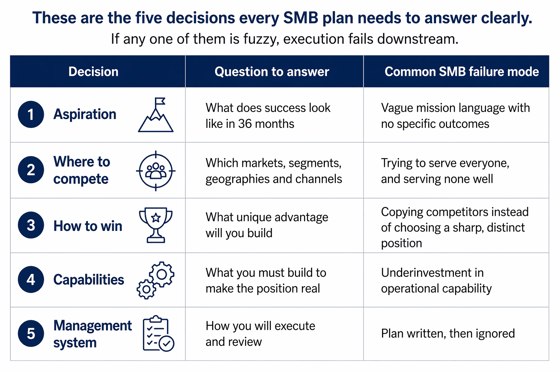
This structure is a variation of one of our GAIN™ Masterclass speaker's approaches, Cliff Bowman, which is adapted for SMBs by stripping out the corporate vocabulary and adding the management system as a fifth, equal decision.
A ten-step strategic planning process for SMBs
This is the process we run inside the QuoLux™ GOLD™ programme. The cycle is designed to be completed in quarters, with regular senior leadership (SLT) contact and to produce a plan the team can start to carry out the day they sign it off.
Step 1: Get the data straight
Before strategy comes obtaining the data - the facts. Pull the last 36 months of:
- Revenue by customer, segment and channel
- Gross margin by the same cuts
- Customer churn and net revenue retention
- Employee turnover by role and reason
- Net Promoter Score or equivalent
- Competitors' visible moves
This is the evidence base. Most SMB plans wobble because they are built on opinion. Get the data first. The argument is then about what to do, not what is true.
Step 2: Run a structured situation analysis
Use one tool deeply rather than three tools shallowly. Our default is a structured strategic review combining:
- A simple SWOT understanding key buying reasons, but with each item evidenced by a specific data point
- Similarly, agreement on what is an attractive market
- A trend scan of the next 36 months in your segments
- A gap analysis of your current capabilities versus the capabilities your aspiration requires
The output is a one-page strategic context. If it is longer than a page, it is too long.
Step 3: Set the aspiration - agree key company goals
Owner-managers often skip this step or hide it inside a vague mission. Resist that. Set a specific 36-month aspiration that names:
- Revenue and margin
- Customer or market position
- Team and capability
- Culture and engagement
- Owner role inside the business
The owner role in the final bullet point above is the one most plans miss. The aspiration is also a statement about what the owner needs to stop doing to focus on the more important work that needs to be done to become more strategic.
Step 4: Choose where to compete
Most SMB failures trace back to scope. Owner-managers say yes to too many segments, too many products, too many geographies. The discipline of “where to compete” is also about choosing what you will not do.
A useful test: name the three customer segments you will serve and the three you will deliberately exit or never enter. If you cannot name the three you will not serve, you have not made the choice yet.
Step 5: Choose how to compete
How to win is the unique advantage you will build inside your chosen field. There are only a handful of structurally durable choices:
- Differentiation via product/service or experience
- Proximity to a specific customer segment
- Ecosystem or platform position
- Speed and agility versus larger competitors
Most SMBs win on differentiation, proximity or speed. The plan needs to name which one order winner and order qualifiers and the evidence that already supports the choice.
Step 6: Identify the capabilities to build
For each “how to compete” choice, name the three to five capabilities you must build that you do not already have at the level needed. Capabilities can be:
- People and skills
- Systems and data
- Processes and ways of working
- Partnerships
- Brand and reputation
This is where SMB plans most often underinvest. McKinsey Global Institute research has documented that SMBs typically underfund operational capability, which is one of the structural reasons SMB productivity sits at roughly half that of large companies.
Step 7: Build a one-page plan on a page
A full plan should not be over 20 pages. On GOLD™, delegates have a plan that is less than 10 pages. A plan can actually run to one which we share in one of the workshops. Print it. Pin it to the wall. Use it at every senior team meeting.
Step 8: Build the management system / control systems
This is the step most SMBs miss and the step that determines whether the plan survives the first quarter.
A simple, effective SMB management system has four moving parts.
- Daily huddles and weekly meetings looking at delivery, metrics
- A monthly senior team operating review of a couple of hours, structured around KPIs and the live priorities
- A quarterly business review of two to three hours, comparing actuals to plan and adjusting next-month priorities
- An annual planning offsite of one to two days, which restarts the cycle
McKinsey research found organisations with disciplined review systems were 4.2 times more likely to outperform peers with revenue growth up to 30 percent higher.
Step 9: Communicate, cascade and engage
A plan that lives only in the senior team is half a plan. The final step is structured cascade.
- Every team has a 12-month plan that ladders into the company plan
- Every team member knows the three priorities for their role this quarter
- The one-page plan is on every wall and every screen background
- The owner tells the strategic story in person to every layer in the first 30 days
Engagement research is consistent on this point. Employees who can connect their daily work to the company strategy outperform those who cannot, and they stay longer.
These are the leading and lagging indicators we look at with QuoLux™ GOLD™ clients.
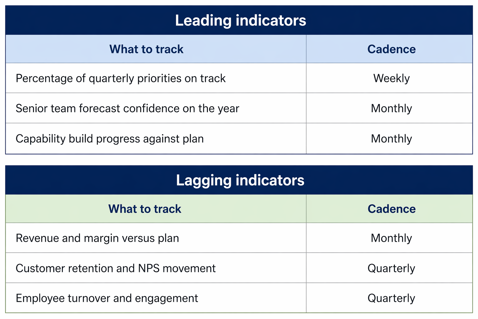
If three or more of the leading indicators are red for two consecutive months, the management system is failing, not the strategy.
Step 10: Relentlessly follow through
Well done! You have a plan. Don’t put it in a drawer and forget about it.
A critical part of your leadership now is the ‘Execution of the actions in the plan’ where you need to lead / drive the change process and relentlessly follow through on those few key aspects that will make a difference.
Common strategic planning failures in SMBs
Across more than a decade of running QuoLux™ GOLD™ with UK SMBs we see the same five patterns repeatedly.
- The plan is written by the most senior person alone and presented as fact. The senior team nods then ignores it
- The plan tries to do too much. Two many priorities is no priorities
- There is no review rhythm. The plan exists. Nothing else does
- The plan is built on opinion, not data, and falls apart at the first hard conversation
- The senior leader does not change their behaviour. The senior team learns the plan is theatre
The fix in each case is structural. Plan as a team. Cap priorities (key company goals) at five. Build the review rhythm before you start the work. Bring the data. Hold each other to account.
A note on the human side
Strategic planning is a numbers exercise wrapped around a human one. The reason most SMB plans fail is not analytical. It is that the senior team does not feel ownership, the owner does not let go, or the conversations the plan demands are conversations the team has never been able to hold.
That is also why peer-cohort programmes like GOLD™ work. Senior leaders learn the discipline of strategic conversation by doing it alongside other senior leaders who are wrestling with the same hard choices.
FAQ
What is the best strategic planning framework for an SMB?
The most usable SMB framework combines a five-decision cascade (aspiration, where to play, how to compete, capabilities, management system) with a one-page plan and a four-tier review rhythm of weekly, monthly, quarterly and annual reviews. It is simpler than corporate strategic planning and more focused on execution.
How long should an SMB strategic plan cover?
The most useful planning horizon for SMBs is 36 months (depending on business this can be 5 – 7 years) for the strategic plan, with a 12-month operating plan inside it and quarterly reviews that adjust both. Plans longer than three years tend to drift into wishful thinking. Plans shorter than 18 months drift into operations.
How often should an SMB review its strategic plan?
A working SMB review rhythm is daily huddles and weekly operating reviews of 60 to 90 minutes, monthly business reviews of two to three hours, quarterly strategy reviews of half a day, and an annual offsite of one to two days. McKinsey research links disciplined review systems with up to 30 percent higher revenue growth.
Why do most strategic plans fail in SMBs?
A meta-review summarised by ClearPoint Strategy found only 12.5 percent of strategic projects are ever completed. The most common failure modes are: too many priorities, no review rhythm, plan written by the senior person alone, plan built on opinion rather than data and the senior leader(s)not changing their own behaviour.
Should an SMB use a consultant for strategic planning?
ICAEW research found SMBs that use external advice see roughly a 22 percent productivity uplift. The strongest model for SMB strategic planning is that the senior team owns the plan, with structured external facilitation and challenge during the design and quarterly review points. Pure consultant-written plans rarely execute because the team does not own them.
Sources
- ClearPoint Strategy, Strategic Planning and Execution Statistics: 2026 Report
- ResearchGate, Strategy implementation: What is the failure rate?
- McKinsey Quarterly, The disciplined management cycle
- ICAEW, SMBs: Mind the Productivity Gap, June 2024
- Bowman, C. What’s your Competitive Advantage, 2019
- Federation of Small Businesses, Small Business Statistics 2026

QuoLux™ is a Certified B Corporation. Our GOLD™ strategic planning programme has helped UK SMB leadership teams design and execute plans they actually implement since 2013, across construction, manufacturing, engineering, food and beverage, professional services and more than a dozen other sectors. To read more about GOLD™ and our other leadership and business growth programmes, please click here.
Keep up-to-date on the latest leadership and management tips by signing up to our weekly blog here