
"Follow the Money" - The Story of a Fascinating Family Business
From modest beginnings two men have forged one of the county's most successful family business partnerships. Now they're preparing to pass it on to the next generation.
This article first appeared in The Raikes Journal on 10th March 2026, after Andrew Merrell interviewed Don Robins about his business.
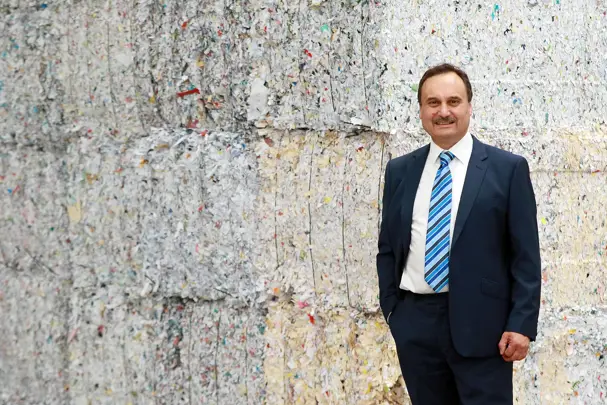
Don Robins, pictured above, tells a story about arriving at a client’s offices wearing a suit, doing the deal to dispose of their wastepaper, then returning to his van to get into his overalls to go back into the business as the removal man.
That was going back years. Brothers Don and Geof Robins were in the early days of establishing their business and did everything themselves. It’s a business they still remain as passionate about all these decades later.
And today they have 80 staff and their business, Printwaste, turns over more than £10 million. Rather than one van it commands a fleet of trucks and transit vans that cover the UK.
When Don was emerging from his van way back when, it was all about paper waste from printers. Printwaste now handles all manner of materials from laptops to polystyrene, electronic equipment, clothing, plastics and more.
It put the emphasis on recycling as much as possible long ago, selling its ‘product’ on what it describes as ‘the commodities market’ - which involves a flurry of phone calls every Thursday to check prices and make the deals with businesses in the UK and beyond.
It’s a fast-moving marketplace requiring an incredibly agile business, and the way Don tells his story you begin to appreciate the appeal and to marvel at what the brothers and their team have created.
“We currently work with 2,000 customers and work across three sites,” said Don.
Jenny Robins, Geof’s daughter, is also in the meeting. She’s operations manager, and understudy to her uncle as one of the next generation readying to take the reins of the Cheltenham-headquartered operation.
“We have clients that take our drivers all over the country. But the core of our work is a 70-to-80-mile radius,” said Jenny.
“Seventy per cent of our business is in Gloucestershire or close to. We have clients in Birmingham, Oxfordshire, Bristol and then further north too.”
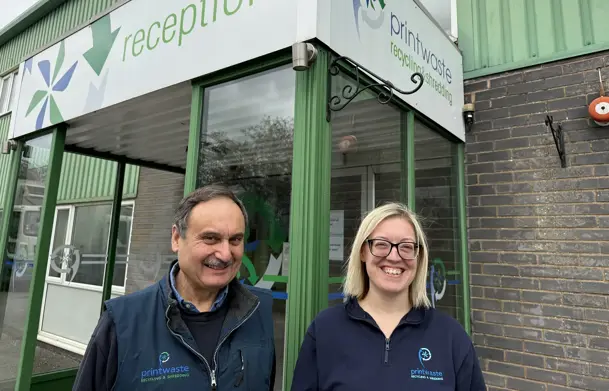 Don Robins and Jenny Robins
Printwaste’s 30 lorries and a dozen transit vans collect product from those customers - and as far north as Hull.
At its Merthyr Tydfil plant in Wales, the first of what were meant to be a series of expansions – cut short by Covid-19 – six to seven of its big trucks leave daily, each carrying 20 to 25 tonnes of ‘product’.
Its Stoke Orchard site, acquired in 2008, is even busier.
“We’ve built ourselves back to where we were since that period (the Covid-19 pandemic), and then some. It was difficult, as we also had to keep working through the pandemic.
“We’re proud of being able to do so. Yes, we could do it again, but we hope we never have to.
“We have clients including the NHS and we had to work out how to continue to support them. It was very difficult, but we did it – and we managed to do it without laying anyone off either,” said Don, who might be stepping back from the helm, but has the sense of a man who would love it to go on just that little bit longer.
As we stare out of the inner window of the viewing gallery on the second floor of its Cheltenham offices down onto its recycling centre, a mini digger is continuously feeding a conveyor belt a shredded paper mix, carrying it into the mouth of an enormous machine.
Minutes later huge wire-wrapped bales of shredded paper emerge down another conveyor like giant 600 kg Weetabix, too heavy for a man to lift, carefully blended to make them suitable material for whatever purpose the buyer has decided – from toilet paper to brand new writing paper, from cardboard to packing.
A small mountain of uniforms awaits a similar fate through the same system, among them what looks like emergency services uniforms, including what might be the hats of senior police officers.
Giant containers are filling with components of all types from showers to computers, also awaiting processing. Fork-lift trucks whizz about, reversing alarms punctuate the constant noise of the munching machines and the roar of departing and arriving trucks.
“You can’t have any uniforms reappearing outside of an organisation or business. We treat them the same as we do the confidential waste we handle,” explained Don, when I ask about the pile of clothes, explaining why they are turned back into material rather than sold on.
Everything they handle seems to come with a detailed agreement about what should happen to it, how, when and for whom.
The world may have rushed to go digital, but Printwaste’s core product remains paper. We may use less, but we also seek to remove as much product as possible from landfill and recycle.
Significant contracts with the likes of the NHS and local authorities demand both confidentiality and a sustainable solution.
“We recognised years ago that to compete with the big boys we needed to adopt the highest sustainable values and be accountable,” said Don, whose ability to see opportunity and act is apparent everywhere.
Business was something he always wanted to go into, but his journey should be an inspiration to anyone whose school career has been less than glittering and who has been told they would be best remaining a foot soldier.
“I messed up at school,” he announces, matter-of-factly. “But I studied for a business qualification at North Gloucestershire College.”
The desire to learn has never left him, as you’ll see below, and he now has letters after his name to prove it.
Adoption of tech has helped Printwaste too, allowing it to deliver reports for clients that show how their waste is disposed of, how much is recycled and what it has been turned into, when and where, at the click of a button.
“We also use Protrack Solutions (a Gloucester business that specialises in tech that not just tracks company vehicles but delivers fuel efficiencies, information about payloads, and more.
“We have to keep moving. It’s what we do. You need to look to the next thing, all the time,” said Don, as if it was that easy.
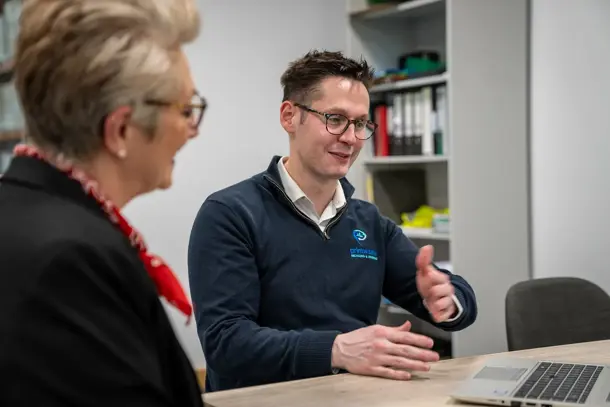 Chris Robins, marketing manager at Printwaste.
If the brothers have had a mantra, he said, it’s “follow the money” - a quote from the famous Hollywood Woodward and Bernstein film, Watergate. Perhaps explaining why the firm also remains so entrepreneurial.
Look up entrepreneur in the dictionary; it also means risk-taker. It’s a fitting description for the pair, but should probably be prefixed with ‘calculated’.
“When we opened this place (its Tewkesbury Rd headquarters) we put everything into it; every last penny,” added Don, smiling at the recollection – as if to say, ‘well, you would, wouldn’t you?’. I want to say ‘most of us probably wouldn’t’, but he’s moved on.
“It was underwritten by Lloyds, but it still took up everything we had at the time.”
Jenny chips in at this point as they tell the story together: “To help cover it, we pitched for some pretty big contracts. I think about five, thinking we might win one or two. We won four.
“The new building gave us the capacity to expand and cope with that.”
And the contracts covered the costs. Onwards and upwards.
Don said, “Growing a business is like taking very big steps. You have to invest and work towards it, and if you are lucky you take that first big step.
“You then have to regroup, work out what you did right, prepare yourself again, and take the next step.”
Perhaps the energy he still exudes, long after most would have retired, comes from the fact he still clearly loves it – and is still looking for Printwaste to make those big steps, even if they will be led by the next generation of management.
“We aim for 10 per cent growth every year. In fact, this year we’re aiming for 15 to 20 per cent. We might do that, but we will perhaps only do 10 per cent, “ he said, when I ask about growth in 2026.
“For an SMB to grow you need to generate profit, that’s where the investment comes from that allows you to take those steps.”
That next generation of management is already in the business - Jenny is being coached by Don, with Geof mainly working from home to give that next generation the floor, but he’s at the end of the phone when needed. Jenny’s brother Chris is marketing manager.
Jenny’s career path has seen her work through the business, starting in the warehouse and sorting lines as she worked her way through college studying to become a teacher.
To her surprise she found herself enjoying the dynamic of the family firm too much, the camaraderie and the non-stop nature of what it does, the dynamic, and has only taken time off since to have her children.
“I find it difficult,” said Don, when I ask him about stepping back from the helm.
“I know how I would do it, but it’s not about how I would do it. It’s about how Jenny does it now, and if that doesn’t go right first time, then I have to let her find her way.
“Succession creeps up on you. I have been planning for it for the last five or six years. I remember my father leaving, and that was quite sudden when he handed the reins over.
“I only began to understand the process a lot better when I joined a group called QuoLux. I have gone through all of their courses now - and got the MBA too.”
Jenny has done two of the courses at the leadership development specialists too and the business is one of many that has chosen to use the Gloucester-based leadership development specialists as its go-to, to bring through its other managers too.
“It helped me a lot,” said Don. “A lot of the thinking is about leading by example. I think it helped me to focus on the things that matter most.
“I got a hell of a lot out of it. It made me realise how important leadership is - in how you behave, how you can inspire people when you are in the business.
“It’s important to get it right, because this is a family business. We work with family here and they will be the next generation to lead the business too.
“Open culture – speaking your mind, being approachable, being able to say what you think.
“We have worked hard to establish that culture where staff can say anything you need to any of us. It will not offend me.”
His mind turns to that added complication for everyone who runs what has become a family business. That it becomes much more than work.
“As a family business you live together and then work together. But because it is a family business it is not a 9 till 5 job.
“I think for it to work you have to have the right partner too. They have to understand it too. I’m incredibly lucky in that respect.
Don’s wife, Sally Robins, has also been a key member of the senior team and remains a director.
“But you have to respect people’s partners too. They have families to think of and relationships too.
“You have to understand everyone is different. We have people who come in and work 9-5, and people who come in and work much longer hours because they want to.
“My wife gets into work at 6am. Some might say that’s to avoid me! I get in about 9am. But I am generally the last one to leave. I like to lock up.
“I’m not a believer in a work-life balance. I have one life, and I live it and enjoy it - whether I am at work or not.”
Keep up-to-date on the latest leadership and management tips by signing up to our weekly blog here