
If the UK's Economy is Shrinking, Why are these Businesses Growing?
More disappointing reports on the UK economy have just been published. Why is it then that a group of businesses with a Gloucestershire connection are achieving an average growth rate off the charts?
This article first appeared in The Raikes Journal after Andrew Merrell joined QuoLux™ at our annual Alumni Showcase Masterclass.
Apparently two-thirds of UK companies do not have a business plan, most don’t invest in training, 90% of our workforce are disengaged and our productivity is poor.
As if that’s not a gloomy enough thought, on Friday 12th December 2025, the Office of National Statistics told us the UK economy had unexpectedly shrunk (0.1 per cent in October).
And then in the week commencing 16th December, with news that the rate of unemployment had risen to a four-year high of 5.1% in the three months to October.
For a country whose current mantra is all about economic growth, it doesn’t read well.
Just two days before the ONS announcement, a private gathering of 100 business leaders took place at a Gloucestershire hotel, revealing a much larger group of companies that on average are enjoying extraordinary growth and confident it will continue too.
All are signed-up members of the leadership development programmes of Gloucestershire-based QuoLux™ and are using what they learn to challenge themselves to change. And that, it seems, is changing the fortunes of their organisations.
The invitation-only get-together at the Chase Hotel was QuoLux’s end-of-year masterclass. The event opened with the launch of a book, Realising Good Growth, co-authored by the company’s chief executive, spelling out the thinking the many organisations it works with are using to achieve just that.
Its cohort now numbers more than 1,000, with figures showing those businesses and organisations have, on average, enjoyed increases in sales of (up 42%), in productivity (up 47%), employee growth (up 19%) and profitability (up 197%).
That apparently amounts to a 2,000% (yes, 2,000) return on investment for participants of the QuoLux™ programmes.
Despite its track record it is a counterculture that has remained on the blindside of policy makers and the powers that be. Or has it?
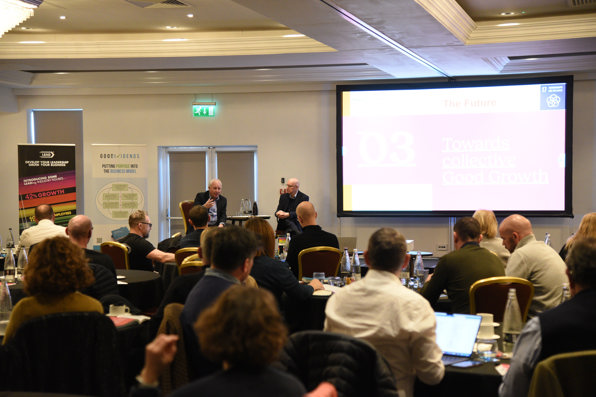
Stewart Barnes and Steve Kempster
The launch of another of QuoLux’s books earlier this year filled the 1873 club at Gloucester Rugby’s stadium. In the audience among the business leaders and local decision-makers was a Downing Street advisor.
For Dr Stewart Barnes, the chief executive officer of QuoLux, the potential is obvious.
“We’ve been measuring this for 15 years now and we know it works,” said Dr Barnes, who was interviewed on stage by QuoLux director Rachael Ramos, alongside Steve Kempster, professor emeritus at Lancaster University and co-author of Realising Good Growth.
“What about the Government investing in leadership instead and creating engagement?
“This will deliver the growth we need. That is the gift that leadership can deliver.”
It’s Kempster who spent years developing the initial leadership theories and building into them the concept of ‘good growth’ - where a well-run business becomes a ‘purpose-led business’, a force for good that delivers ‘good dividends’ for people and planet as well as a healthy profit.
And it is QuoLux™ that has helped hundreds of businesses take what Kempster called ‘the road less travelled’ and put those ideas into practice.
Andy Barham, managing director of Gloucester-based kitchen-maker Premiere Kitchens, an alumnus of QuoLux’s LEAD™, GOLD™ and GAIN™ programmes, is one such business leader.
His story is also one of the case studies featured in Realising Good Growth, and along with three other organisations he took to the stage at the masterclass to tell his story - why he chose QuoLux™ and what impact his learning was having on Premiere Kitchens.
Interviewed by Victoria Petkovic-Short, of Cheltenham-headquartered APT Marketing, Barham said he had been handed control of the Gloucester business by owners Markey Group and challenged with growing it – and then the Covid-19 pandemic had happened.
“We went from £16 million to £11 million turnover but still suffered a loss, albeit much reduced,” said Barham, who admitted that as a competitive individual he had felt the blow both personally and professionally.
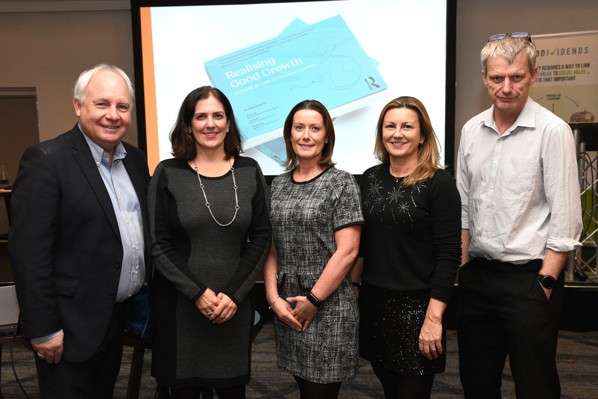 QuoLux™: Stewart Barnes, Rachael Ramos, Keeley Witts, Jo Draper and Simon Townsend
By way of reaction he looked first to develop his own skills and that is when he found QuoLux™.
“What it has given us is the ability to create an engaged workforce and instil purpose into what we do,” explained Barham, and that, he said, was proving transformational.
The detail is in the book, but the bottom line makes for powerful reading.
Between 2019/20 and 2024/25 revenue for Premiere Kitchens went from £11 million to £22 million, gross margin increased from 24 per cent to 37 per cent, net profit up from £100k to £2 million for the full year this year, and productivity by 50 per cent.
Becoming a £50 million turnover business, he said, was now an aspiration.
For The Nelson Trust, the Gloucestershire-headquartered South West-wide charity dedicated to transforming lives affected by addiction and multiple disadvantages, its path had been different but no less transformative.
Christina Line and Kirsty Day, who have both worked with QuoLux™ on different programmes, told Petkovic-Short about a dramatic ‘David and Goliath-like’ battle for a major contract.
“We were up against G4S, a global firm with huge resources and teams to help put together its bid,” said Line.
The global security company is one of the world’s largest private employers, operating in more than 85 countries and employing an estimated 800,000 staff.
“We were up until 5am, a small team writing our tender – 20,000 words - and we were thinking ‘we’re not going to win’.
“And ‘yes’, there may well have been an SOS call to Stewart involved too,” added Line.
Barnes pointed them to QuoLux’s ‘SDG configurator’, a digital tool that helps businesses quickly understand how their operations align with 17 of the United Nation’s Social Sustainable Development Goals.
For an organisation needing to demonstrate purpose and it's wider social impact the configurator makes this possible, quickly and easily.
For the relative minnow from Gloucestershire up against the giant that is G4S it proves key.
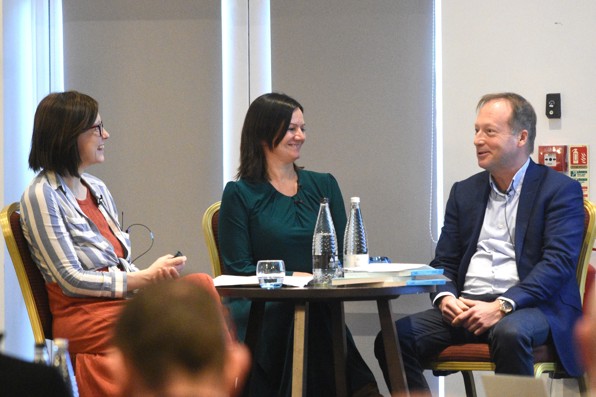 Victoria Petkovic-Short of APT Marketing with Hayley Coombs and Luke Freeman of MF Freeman
Luke Freeman and Hayley Coombs (pictured above, centre and right, with Victoria Petkovic-Short), of housebuilder Freeman Homes, spoke candidly about the battle to transfer the concept of ‘Good Dividends’ into a highly competitive sector where pressure is huge, margins are everything and profits a necessity.
“There can be a lot of resistance to social value in construction. People can see compliance as onerous and in the way of profit,” said Freeman, the Forest of Dean firm’s CEO.
“We have a board. Every member has a mortgage to pay. People don’t necessarily rush to engage in a process unless it will generate profit.
“But when you start looking at your business through a different pair of eyes, you realise you are already doing a lot of this anyway, you just have to utilise it.
“When you see how transformative that can be, suddenly it starts to make sense to everyone because it becomes a strength that helps sell what you do and why.”
A clearer sense of purpose, better communication - especially with regards to community, the environment, affordability, sustainability, locally sourcing materials and creating jobs – were now visible elements proving transformative for the already award-winning firm.
But perhaps the case study that most dramatically demonstrated how veering from the well-trodden path in search of original solutions could be transformative was the presentation by Justin Young and Louise Woodward, of Cotteswold Dairy.
The Tewkesbury family firm and major employer explained how a challenging jobs market had led it to develop placements for carefully chosen inmates from Leyhill Prison.
It was a trip way outside its comfort zone which risked so much, but had proved successful on levels the business could never have imagined; inspiring staff, developing new skills, transforming both the lives of the inmates and how everyone viewed the firm and what it stood for.
The estimated financial benefit is summed up as £250,000 in savings and increased production.
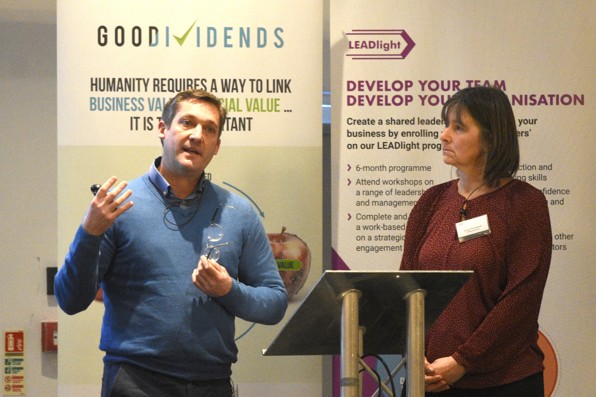 Justin Young, Operation Director, and Louise Woodward, Director, of Cotteswold Dairy
Andy Allen, chief executive officer of search engine optimisation business Hike, was at the event and is one of those case studies featured in Realising Good Growth.
“We got EIS investment. The VC (venture capital) company likes to push the partners in the companies they invest in into developing their leadership skills and developing a culture of self-improvement in the business,” said Allen.
“One of them suggested I went through QuoLux™ and that I should speak to Stewart. I did that, and he walked me through what they do, and it resonated with me.
“What is also invaluable is to be among your peers. They may not be in the same line of work as you, but you get to float ideas with people in confidence and solve some of those challenges too.”
Geoffrey Newsome, chief executive of tech charity ITSA Digital Trust, called the masterclass “inspiring”.
“Stewart and Steve outlined an opportunity for businesses to divert from the path of minimal growth and global disaster and instead lead humanity into a new era in which organisations have strategies for growth, improved productivity and higher profits which can succeed because they are built upon the vital regeneration of people and the planet.
“Then we heard from organisations which have planned their growth in this way and are flourishing,” said Newsome, whose charity collects, refurbishes and distributes computers and tech to schools both in Gloucestershire, the UK and across Africa.
“One of the huge possibilities is for businesses and charities to work together, which really lights my fire.
“I have worked in both the business and charity sectors, and I know first-hand how passionate people can be in both.
“Just imagine how much sustainable growth we could create if we united our passions! That’s the future that we can bring about.”
He described QuoLux’s LEAD™ course as “a revelation”.
“Yes, it is underpinned by leading research from university professors and business leaders about how to lead organisations to greater success.
“But it also shows us how to create real and immediate improvements in ourselves and in our organisations.
“It is full of practical exercises, tools, feedback, coaching and exposure to other leaders and organisations so that we can quickly begin to test and apply what we learn.
“The course was recommended to me by leaders who have grown their organisations because of it.
“Now that I and my organisation are on that exciting journey, I know exactly why they recommended it.”
The next LEAD™ programme starts on 21st and 22nd April. If you'd like to join this unique community that consistently outperforms the market, please get in contact with us here - we'd be pleased to talk.
Keep up-to-date on the latest leadership and management tips by signing up to our weekly blog here